
CLOUD ARCHITECTURE SOLUTIONS
Build high-performance systems with cloud architecture solutions, DevOps, and microservice infrastructures. Professional solutions for SaaS and IoT projects.
The right architecture, our services for sustainable growth...
Cloud Architecture Design
In our cloud architecture projects, we design flexible architectures compatible with cloud services (AWS / Azure / GCP). We build highly available (HA) and fault-tolerant systems for uninterrupted business continuity, while keeping your infrastructure operational even during unexpected crises with multi-region disaster recovery (DR) plans.
Real-time and Event-based
Raw data filtered from IoT devices is received by the message broker and transferred to a seamless stream. This data, processed in real-time, is reflected on the end-user screen (client) via APIs within milliseconds.
Device → Broker → Stream → Processing → API → Client
Migration to Cloud and the Cost
Based on our experience with various projects, a successful cloud migration is more than just moving systems; it’s about optimizing the architecture. We migrate your legacy systems with minimal downtime, instantly identifying idle resources and balancing your cloud costs without sacrificing performance through intelligent auto-scaling strategies.
What is Cloud Architecture?
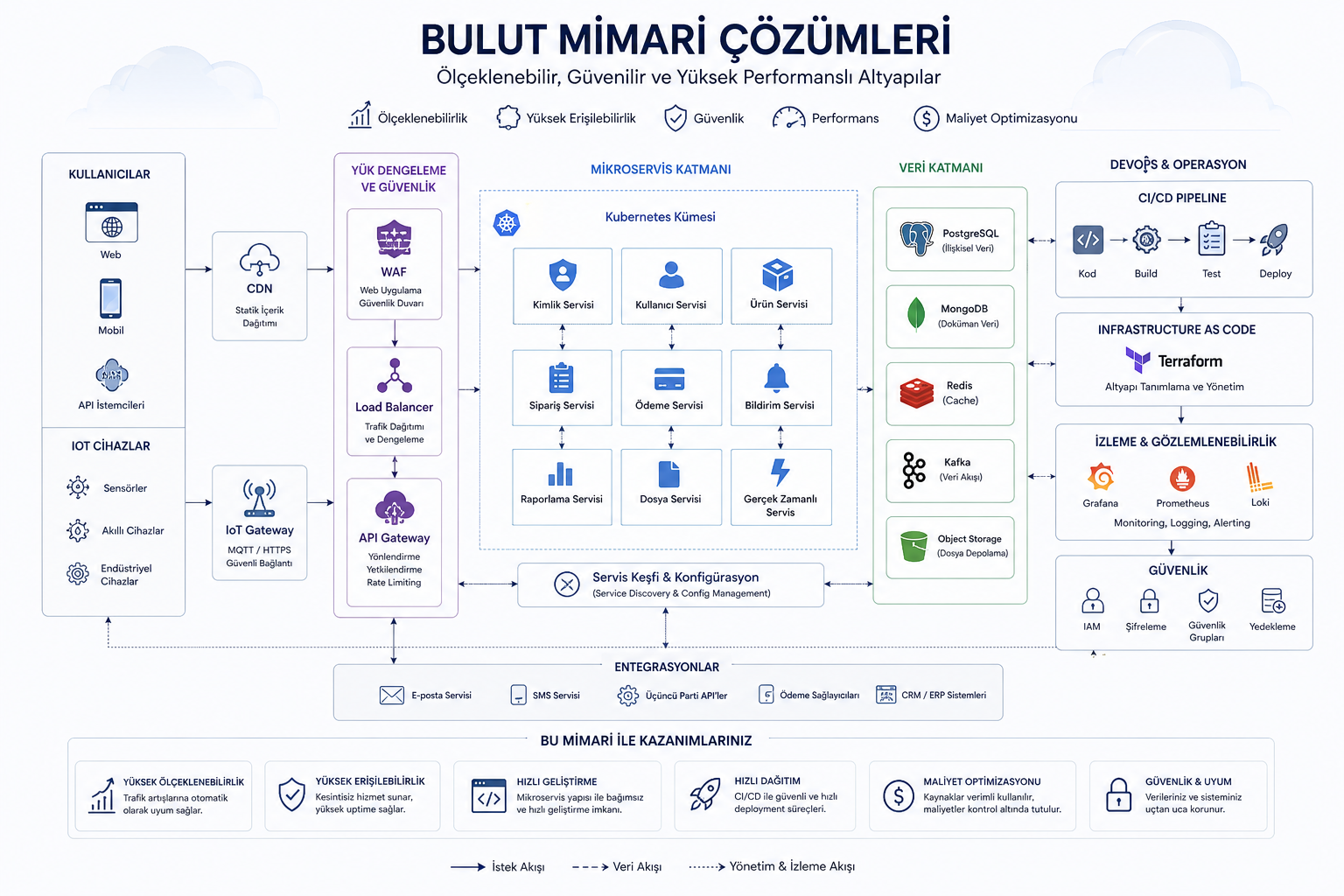
Cloud architecture is an approach that enables applications to be designed in a distributed, flexible, and scalable manner.
Main objectives:
- Auto-scaling for instant response to load increase
- High availability for uninterrupted service
- CI/CD for fast and secure deployment
- Cost optimization to prevent unnecessary expenses
According to our experience, a properly established architecture:
- Reduces deployment times from hours to minutes
- Significantly reduces operational load
- Maintains system stability in the long term
Why is it needed?
The biggest risk in modern digital products is not that the application doesn’t work; it’s that it slows down under load, becomes unscalable, and is not operationally sustainable.
This is especially true for SaaS platforms, real-time applications, and IoT systems:
- Traffic increases instantly
- Data flow must be uninterrupted
- Systems must be accessible 24/7
A situation we frequently encounter in our projects:
Systems that are rapidly developed initially face performance bottlenecks, deployment problems, and high costs during the growth phase.
At this point, a well-designed cloud architecture and DevOps approach become not just a technical choice; they become a fundamental factor directly determining the success of the product.
Future-Ready Systems with Cloud Architecture
Cloud architecture determines not only the present but also the future of your product.
When implemented correctly:
- Your system will be ready for scalability
- Your operational load will be reduced
- User experience will remain stable
In the coming period:
- AI-powered systems
- Edge computing
- Real-time data processing
Functions such as these are expected to become more critical.
To be ready for this transformation, it is necessary to build the right architecture today.
FAQs about Cloud Architecture Solutions
This timeframe depends on the scope of the project and the existing infrastructure. However, in practice:
- Simple MVP infrastructure: 1–2 weeks
- Medium-sized SaaS architecture: 3–6 weeks
- Complex (IoT / real-time / multi-region): 6–12 weeks
These timeframes generally include:
- Infrastructure design
- CI/CD pipeline setup
- Monitoring & logging integration
In our experience, the biggest mistake is skipping the architectural design phase to speed up the process. This leads to much greater time loss later on.
Yes, if you want to grow.
Manual deployment might be possible in small projects. However, as the system grows:
- Deployment times increase
- The risk of errors increases
- Rollback becomes more difficult
With DevOps:
- Deployment is done in minutes
- Errors are caught early
- Processes become automated
The clear difference we see in our projects:
Teams without DevOps spend most of their time on operational problems, while those with DevOps spend it on product development.
No, it’s not necessary for every project.
Our recommended approach:
- MVP / early stage:
Simple, quickly deployable architecture (monolith + basic cloud setup) - Growth stage:
Gradual transition to modular architecture and DevOps processes
The most common mistake: Installing Kubernetes before there are any users
This approach creates unnecessary costs and complexity.
Our approach:
Architecture as needed, transformation at the right time.
Cloud costs are not fixed; they are usage-based. Key cost components include:
- Compute (servers/containers)
- Storage (data storage)
- Network (traffic/data transfer)
- Managed services (DB, queue, cache)
Factors affecting cost:
- Traffic volume
- Data volume
- Type of services used
- Accuracy of architectural design
For cost optimization:
- Using auto-scaling
- Disabling unnecessary resources
- Correct instance selection
- Using cache and CDN
In our experience, a well-designed architecture can:
provide the same performance at 20-40% lower cost.